
Account
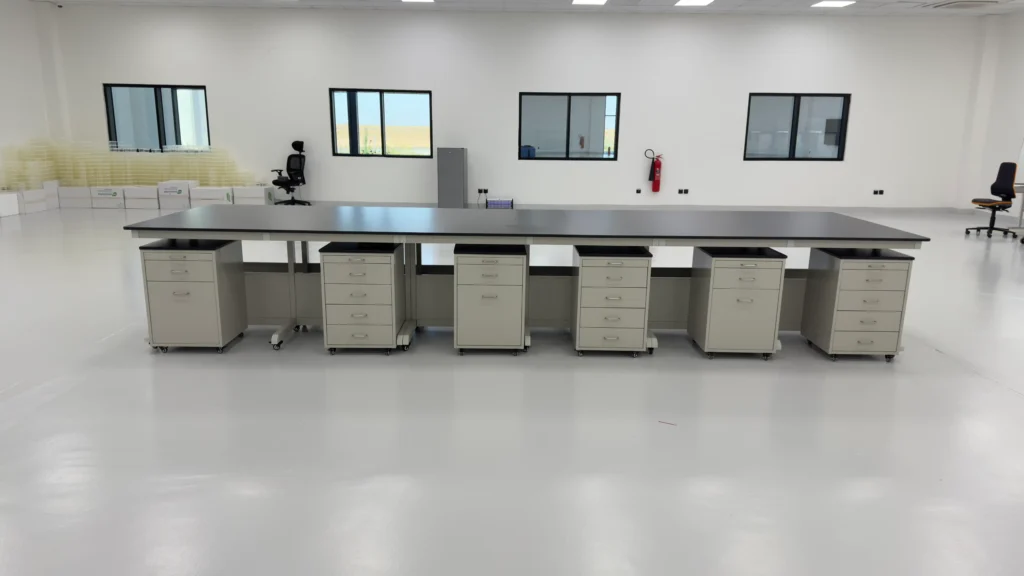
Laboratory furniture isn’t one-size-fits-all, and the frame structure underneath a bench matters just as much as the worktop on top. Over the years supplying and installing lab furniture across Saudi Arabia, I’ve found that clients rarely start out knowing the difference between a C-frame and an H-frame bench — understandably, since it’s not something you think about until you’re actually planning a lab. Here’s a practical breakdown of the main furniture types we work with, and where each one fits best.
A C-frame bench is built with a support structure shaped like the letter C when viewed from the side — open at the front and bottom, with the frame running along the back and sides. This design leaves the underbench area largely open, making it easier to route utility lines (electrical, water, gas) along the back frame without them being visible or in the way. C-frame benches work well where underbench storage isn’t the priority, but clean access to utilities and legroom underneath is.
An H-frame bench uses a structural support shaped like the letter H — vertical supports on both sides connected by a horizontal cross-member for added rigidity. This gives the bench more structural strength, which matters for heavier equipment loads or benches that need to support significant weight across a long worktop span. H-frame construction is common in industrial and heavy-use lab settings where durability under continuous load is the priority.
A K-frame uses a diagonal bracing structure (resembling the letter K) for lateral stability — particularly useful for benches that need to resist sideways movement or vibration, such as those supporting sensitive instruments or equipment that generates motion during operation. The diagonal bracing distributes load more evenly through the frame’s structure.
Modular workbenches are designed as interchangeable, reconfigurable units — sections that can be added, removed, or rearranged as a lab’s layout needs change over time, without needing to replace the entire bench system. This is a good fit for labs expecting to grow, change function, or need flexibility in how the space is used from year to year. We covered the specifics of our modular furniture range, including exact specifications from a recent installation, in our Mobile Lab Furniture page.
Mobile cabinets and mobile bench units sit on locking castors, allowing them to be repositioned as needed rather than fixed permanently in place. This suits labs that regularly reconfigure their space for different projects, teaching layouts, or equipment needs, and it makes cleaning and maintenance around and underneath units considerably easier.
An island bench stands independently in the center of a room rather than against a wall, accessible from all sides. This layout is well suited to collaborative lab work, where multiple people need simultaneous access to the same workspace, and it typically requires more careful planning — particularly for utility connections (water, drain, electrical), since services need to reach the bench from below or through a central connection point rather than a nearby wall. We go into more detail on planning island benches correctly, including our recommendation for centralized electrical looping, in our Laboratory Design Checklist.
Whichever frame type is chosen, electrical planning has to follow the actual equipment that will sit on that specific bench, not a generic assumption. Each piece of equipment has its own voltage, amperage, and socket requirements, and these need to be confirmed and shared with the electrical team before installation, not worked out afterward. This is especially important for benches with mixed equipment loads, where undersized wiring or the wrong socket type in the wrong position can mean rework once the real equipment arrives. Getting the electrical points positioned to match exactly where each piece of equipment will actually sit on the bench also keeps cabling tidy and avoids trailing cords across a workspace, which is itself a safety concern.
Extraction arms should be planned around the specific piece of equipment producing fumes, heat, or particulates — not placed generically along a bench. Before finalizing bench layout, identify exactly which equipment on that bench needs local extraction, then position the extraction arm’s reach and mounting point around that equipment’s actual working area, not just wherever there’s convenient space. An extraction arm placed too far from the source loses much of its effectiveness, while one placed correctly captures fumes right at the point they’re generated. This is worth deciding at the same time as furniture type and electrical planning, since extraction arm mounting can affect what frame structure and bench configuration makes sense in that area.
Most real labs don’t use just one furniture type — a typical layout might combine H-frame perimeter benches for heavy equipment, a C-frame section for a workstation needing open utility access, a modular or mobile section for flexibility, and an island bench for collaborative work in the center. The right combination depends on the lab’s actual function, equipment list, and how the space needs to work day to day — which is why we always recommend starting with a proper space and equipment plan before choosing furniture types, as we covered in our earlier planning checklist.
MUSK Scientific supplies and installs laboratory furniture across Saudi Arabia, including Riyadh, Jeddah, Khobar, and other major cities, alongside our home base in Dammam. If you’re planning a new lab and aren’t sure which furniture types fit your space, get in touch — we’re happy to walk through the options with you.
— Muhammad Faisal Ansari, Lab Furniture Expert, MUSK Scientific