
Account
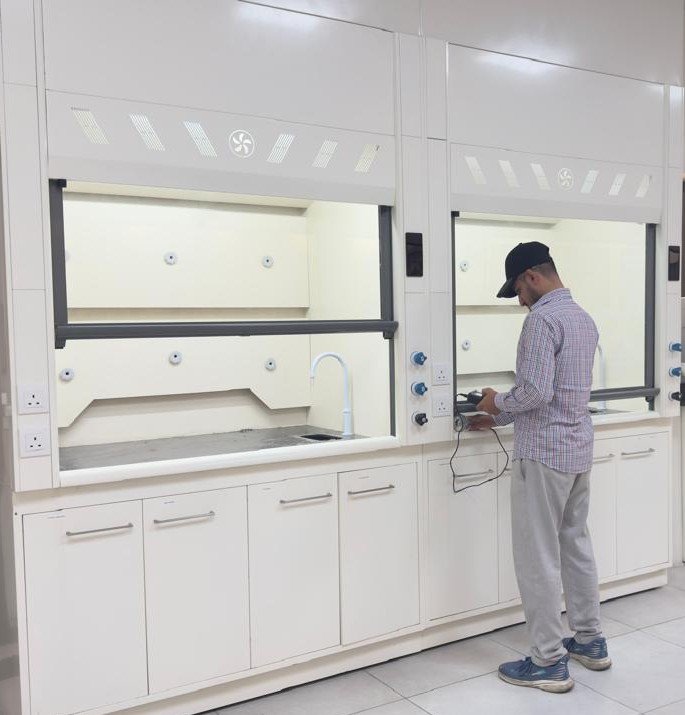
Choosing a fume hood is one of those decisions that looks simple on a spec sheet and gets complicated fast once you’re actually setting up a lab. I’ve spent years installing and calibrating fume hoods across labs in Saudi Arabia — from small university research rooms to full industrial testing facilities — and the same questions come up almost every time: which type do we need, how big should it be, and will it actually keep our people safe day to day. Here’s how I walk clients through that decision.
The biggest mistake I see is choosing a fume hood based on room size instead of the chemistry happening inside it. A hood handling occasional light solvent work has very different requirements than one exposed to concentrated acids or corrosive vapors daily. Before anything else, we look at what’s actually being used inside — what chemicals, how often, and in what quantities — because that determines both the hood type and the materials it needs to be built from.
A hood that’s too small forces awkward, cramped work — which itself becomes a safety issue. Too large, and airflow efficiency drops, since the fan has to move more air than necessary to maintain safe face velocity. We typically size a hood around the actual equipment and glassware that needs to sit inside it during real experiments, not just the empty counter space available.
This is where a lot of installations go wrong. A fume hood’s protective effect depends entirely on maintaining correct face velocity — generally in the 80-120 feet per minute range for most standard applications — and that number can be thrown off by something as simple as poor duct routing, an undersized fan, or the hood being installed too close to a doorway or air vent that disrupts airflow patterns. This is really where installation expertise matters as much as the hood itself; even a well-built fume hood performs poorly if it’s not commissioned and balanced correctly on-site.
When our team installs a fume hood — whether it’s a single unit in a university lab in Riyadh or a full bank of hoods across an industrial facility in Jeddah — we don’t just bolt it into place. We check ductwork routing, confirm the fan is properly matched to the hood’s static pressure requirements, test and calibrate face velocity across the sash opening, and make sure the surrounding room’s HVAC isn’t fighting against the hood’s exhaust. Calibration isn’t a one-time thing either — regular checks keep performance consistent as filters age or ductwork settles.
Getting these right before installation saves a lot of trouble later — both in safety terms and in avoided rework.
MUSK Scientific supplies, installs, and calibrates fume hoods for laboratories across Saudi Arabia, including Riyadh, Jeddah, Yanbu, and Qassim, alongside our home base in Dammam. If you’re planning a new lab or reassessing an existing setup, get in touch — happy to talk through what would actually fit your facility.
— Muhammad Faisal Ansari, Lab Furniture Expert, MUSK Scientific