
Laboratory Gas Tubing Leak Testing
MUSK Trading — Laboratory Gas Systems
Laboratory Gas Tubing Leak Testing
Professional Leak Detection for Laboratory Gas Distribution Systems
Reliable laboratory gas systems require properly installed tubing, fittings, valves, regulators and gas outlets, followed by appropriate inspection and testing.
MUSK Trading provides professional laboratory gas tubing inspection and leak testing for new installations, existing laboratory gas systems, commissioning, maintenance and modification activities across Saudi Arabia.
Inspect. Detect. Verify. Document.
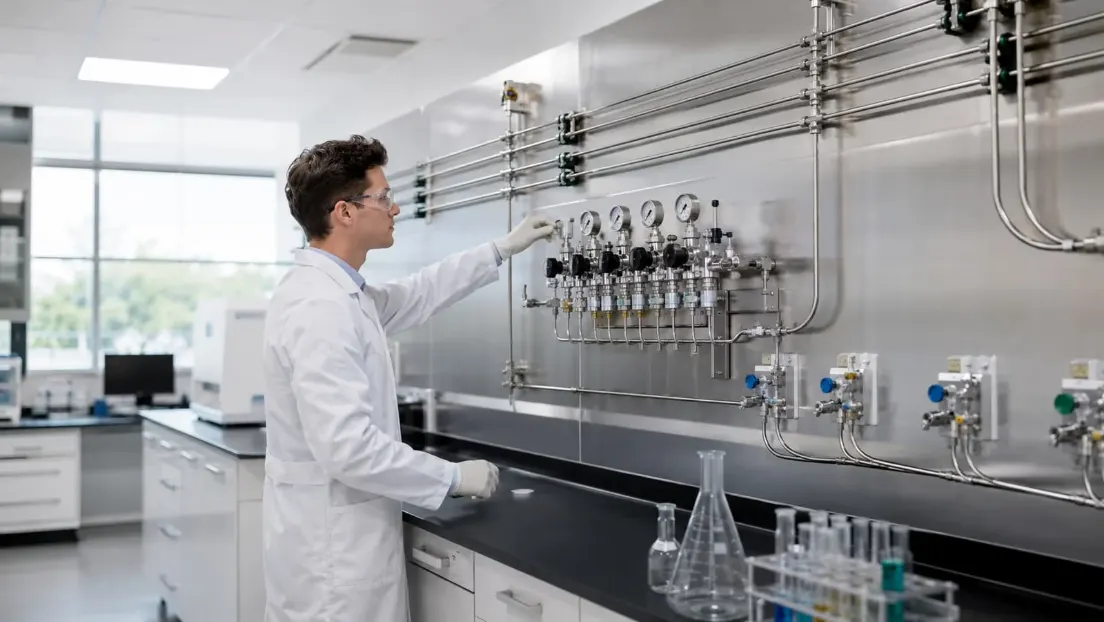
Overview
Laboratory Gas Tubing Leak Testing & Inspection
A laboratory gas distribution system must maintain integrity throughout the complete gas pathway, from the gas source to the point where it reaches laboratory equipment.
Gas Source→
Gas Manifold→
Pressure Regulation→
Distribution Tubing→
Isolation Valves→
Gas Outlets→
Laboratory Equipment
Leakage may occur at any accessible point along this pathway — including compression fittings, tube connections, valves, regulators, manifolds, gas outlets, adaptors, flexible connections and equipment inlet connections. MUSK provides inspection and leak-testing services for accessible laboratory gas systems.
Testing may be performed for: new installations, existing gas systems, pre-commissioning, commissioning, maintenance, modifications, troubleshooting suspected leaks, and post-repair verification.
The exact test boundary, test method, test pressure, duration and acceptance criteria depend on the gas service, system design, equipment condition, client requirements, project specification and governing standards.
System Diagram
Laboratory Gas Distribution & Inspection Points
Typical laboratory gas pathway with the accessible points MUSK inspects during leak testing.
Custom technical diagram — inspection points are marked at fittings, valves, regulators, manifold, outlets and the equipment connection.
Scope & Responsibility
Laboratory Equipment Isolation Before Testing
Client / Equipment Owner Responsibility
Where laboratory equipment, analyzers, instruments or other gas-consuming equipment is already connected, the client/equipment owner is responsible for coordinating with the equipment manufacturer or authorized supplier when disconnection or isolation of the equipment is required.
MUSK will not disconnect, open, modify or interfere with laboratory equipment unless such activity is specifically included in the agreed scope and authorized by the equipment owner/manufacturer.
If Equipment Remains Connected
Where equipment remains connected and the existing gas piping is available for inspection, MUSK can perform an accessible existing-system leak inspection using appropriate methods including visual inspection, bubble leak testing and suitable gas detection.
Important
MUSK does not assume that connected laboratory equipment can withstand a pressure-test condition. The pressure rating of connected equipment must be verified before any pressure test is applied.
Existing Systems
Leak Testing of Existing Laboratory Gas Tubing
For existing laboratory gas systems where equipment is already connected, MUSK can inspect accessible portions of the existing gas distribution system without unnecessarily disturbing laboratory instruments.
Existing System→
Visual Inspection→
Bubble Test→
Gas Detector→
Leak Identification→
Corrective Action→
Retest→
Documentation
This is an existing-system leak inspection / service-condition approach. It is not automatically a high-pressure pneumatic strength test. If a formal pressure test is required, a separate approved test boundary and test procedure must be established.
Methods
Our Laboratory Gas Leak Detection Methods
 01
01
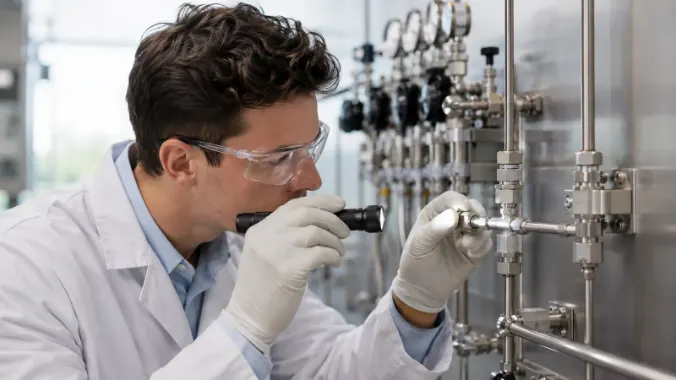
Visual Inspection
The first examination stage. Inspects tubing condition, compression fittings, tube connections, valves, regulators, manifolds, gas outlets, supports, visible damage, corrosion where applicable, improper connections, signs of previous leakage and physical damage.
Visual inspection alone does not prove gas-tightness. It is the first stage of the inspection process.
 02
02
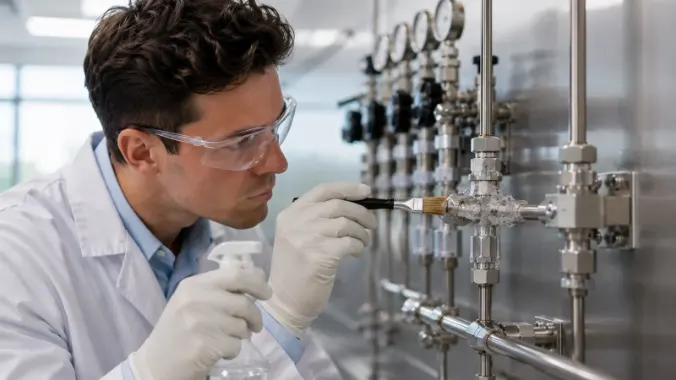
Bubble Leak Test
An appropriate bubble-forming leak detection solution is applied to accessible pressurized connections where the method is suitable — compression fittings, tube connections, valves, regulators, manifolds, gas outlets and accessible threaded connections.
Continuous bubble formation indicates leakage from the inspected connection or component. Reference: ASME Section V, Article 10 — Bubble Test / Direct Pressure Technique.
 03
03
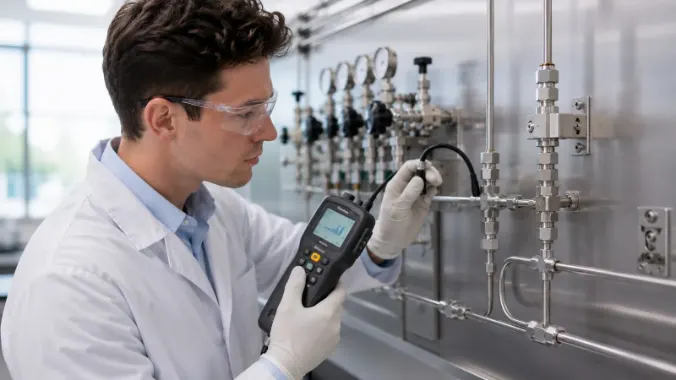
Gas Detector Testing
Where technically appropriate, MUSK uses suitable gas detection equipment to identify the presence of a specific gas around accessible connections — for existing gas systems, suspected leakage, service-condition inspection, locations unsuitable for bubble testing, or client-requested enhanced detection.
The detector must be suitable for the specific gas being tested and operated according to the manufacturer’s instructions.
The suitability of each method depends on the gas service, system condition, pressure, accessibility, materials and the approved test procedure. No single detector is suitable for every laboratory gas.
Gas Services
Laboratory Gas Systems We Support
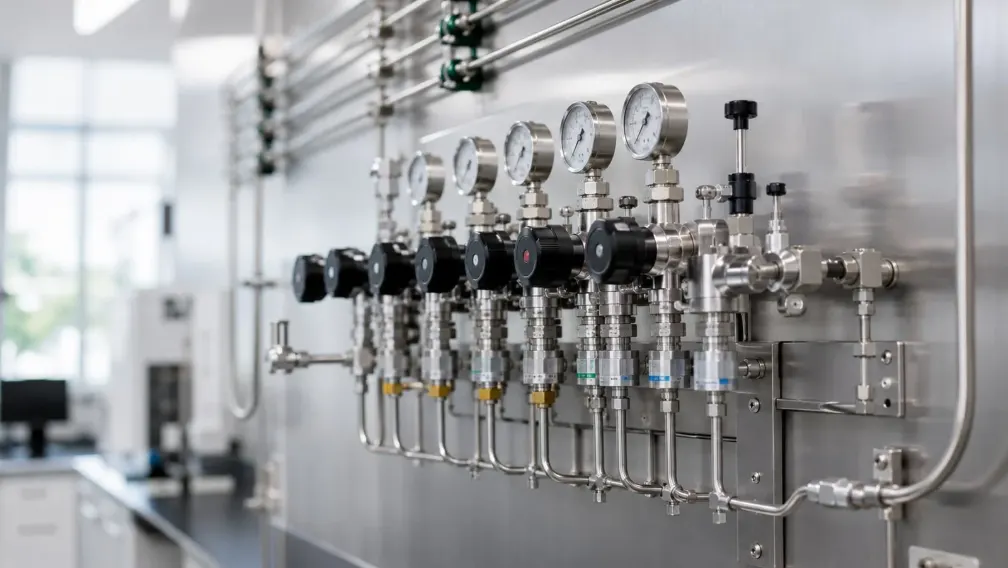
Nitrogen
N₂
Helium
He
Argon
Ar
Oxygen
O₂
Carbon Dioxide
CO₂
Compressed Air
Instrument & utility air
Hydrogen
H₂
Vacuum Systems
Laboratory vacuum lines
Specialty Laboratory Gases
Calibration gases, gas mixtures and other application-specific laboratory gases.
Testing requirements are not identical for every gas. Gas compatibility, pressure, tubing material, cleanliness requirements, detection method and applicable project standards must be considered before testing.
Process
Our Laboratory Gas Tubing Leak Testing Process
01
System Review
Review drawings, gas list, tubing arrangement and project requirements.
02
Test Area Identification
Identify accessible tubing, fittings, valves, regulators, manifolds and gas outlets.
03
Equipment Condition Review
Determine whether laboratory equipment is connected and whether isolation/disconnection is required.
04
Client / Manufacturer Coordination
Where equipment must be isolated or disconnected, the client coordinates with the equipment manufacturer or authorized supplier.
05
Visual Inspection
Inspect accessible tubing and components.
06
Bubble Leak Testing
Apply appropriate leak-detection solution to accessible pressurized connections where suitable.
07
Gas Detector Testing
Use appropriate gas detection equipment where technically suitable.
08
Leak Identification
Identify and document accessible leakage locations.
09
Corrective Action & Retesting
After repair, repeat the applicable leak test.
10
Final Documentation
Record the test information and provide documentation according to the agreed project scope.
Testing Approach
Pressure Testing vs Leak Testing
Formal Pressure Test
Defined test boundary • Approved test pressure • Controlled pressurization • Pressure monitoring • Applicable code/project requirements • Pneumatic safety controls where applicable • May require equipment isolation • Formal test documentation
Existing-System Leak Inspection
Existing/service condition where appropriate • Accessible piping inspection • Visual inspection • Bubble test • Gas detector • Leak identification • Corrective action • Retesting • Inspection documentation
MUSK determines the appropriate testing approach based on whether the system is new, existing, connected to laboratory equipment, undergoing commissioning, maintenance or modification.
Terminology
Understanding Laboratory Gas Test Pressure
Operating Pressure
The pressure at which the laboratory gas system normally operates.
Design Pressure
The pressure used by the engineering design to establish the required pressure rating of the piping system under specified design conditions.
Test Pressure
The pressure selected for a particular test according to the applicable code, project specification, design pressure, test boundary and component ratings.
There is no single universal laboratory gas test pressure. The applicable value is always established from the governing code, project specification and component ratings for the specific system being tested.
Technical Basis
What Pressure Does ASME B31.3 Use for Pneumatic Testing?
For an applicable pneumatic test under ASME B31.3, the test pressure is generally not less than 1.1 × design pressure, subject to the code’s applicable upper limits and component limitations. The pneumatic test pressure must not exceed applicable code limitations and component ratings.
Example A
Design Pressure = 100 psi
1.1 × Design Pressure = 110 psi
Example B
Design Pressure = 300 psi
1.1 × Design Pressure = 330 psi
MUSK does not automatically test every system at 1.1 × design pressure. The final test pressure must be confirmed from the approved project/test procedure, design conditions and ratings of all components within the test boundary.
Common Misconception
What Does 1.5 × Design Pressure Mean?
1.5 × design pressure means 150% of the design pressure. For example, if the design pressure is 300 psi, 300 × 1.5 = 450 psi.
1.5 × Design Pressure Is Not the Pneumatic Test Pressure
1.5 × design pressure must NOT automatically be presented as the pneumatic test pressure for laboratory gas tubing. The applicable pneumatic test pressure under ASME B31.3 has a different basis. The 1.5 × figure is associated with the hydrostatic test basis and should not be used automatically for pneumatic testing.
The actual test pressure must always be established from the applicable code, project specification, approved test procedure, design pressure and lowest-rated component.
Saudi Aramco Standard
Saudi Aramco SAES-A-004 — General Requirements for Pressure Testing
SAES-A-004 is a Saudi Aramco engineering standard governing pressure-testing requirements. It addresses test preparation, test boundaries, test medium, test pressure, test duration, pneumatic testing, preliminary leak testing, controlled pressurization, pressure relief, safety, stored-energy controls, inspection, documentation, pre-start-up leak testing and service testing.
SAES-A-004 supplements applicable piping codes and provides Saudi Aramco-specific requirements and controls.
Preliminary Check
What Is the 25 PSI Preliminary Leak Test?
Under the applicable Saudi Aramco SAES-A-004 pneumatic pressure-testing procedure, a preliminary leak test is performed at 25 psi before pneumatic pressure testing. The preliminary leak examination uses the applicable leak-testing method, including the bubble-test approach referenced through ASME Section V, Article 10.
25 psi is a preliminary pneumatic leak-check pressure. It is NOT automatically the final service pressure or final pneumatic strength-test pressure.
During pneumatic pressure testing, pressure is increased gradually and in a controlled manner. The preliminary stage is limited to the applicable lower pressure before further controlled increases.
Below 1,000 PSI
Pre-Start-Up Leak Testing for Applicable Systems Below 1,000 PSI
For applicable new systems with maximum operating pressure below 1,000 psi, SAES-A-004 provides for an inert-gas pre-start-up leak test at available inert-gas pressure not exceeding maximum operating pressure, or at a pressure recommended by the responsible engineering authority, followed by a service test at normal operating pressure.
MUSK does not simply select an arbitrary pressure. The applicable test pressure is confirmed from the approved test package, operating pressure, design conditions and component ratings.
Saudi Aramco Standard
Saudi Aramco SAES-L-150 — Pressure Testing of Plant Piping and Pipelines
SAES-L-150 is a Saudi Aramco engineering standard covering pressure testing of applicable plant piping and pipelines, including relevance to pressure testing, leak testing, plant piping, applicable instrument tubing, test pressure, test duration, equipment protection and instrument disconnection where necessary.
For applicable instrument impulse lines, SAES-L-150 contains a requirement for pneumatic testing using air or nitrogen at 1.1 × the design pressure of the connected piping/process equipment, with a minimum duration of 30 minutes, and instrumentation that could be damaged by the test is to be disconnected.
This requirement should NOT automatically be generalized to every laboratory gas tubing system. The applicable test category must first be confirmed from the project design and governing requirements.
Examination Method
ASME Section V, Article 10 — Leak Testing
ASME Section V, Article 10 provides applicable leak-testing examination methods. For this website’s leak-inspection methodology, the relevant technique is the Bubble Test / Direct Pressure Technique: an appropriate bubble-forming solution is applied to an accessible pressurized connection, and continuous bubble formation indicates leakage.
Purpose: identify leakage, locate leaking joints, examine fittings, check accessible connections, and verify after repair. This is not the only leak-testing method available.
Repair Guidance
ASME PCC-2 — Repair of Pressure Equipment and Piping
ASME PCC-2 provides requirements and guidance for repair of pressure equipment and piping and related in-service activities, including repair activities, testing after repair, pneumatic-test safety considerations, stored-energy considerations and in-service piping work.
ASME PCC-2 is not represented here as the primary piping design code.
Reference
Technical Standards Summary
| Standard | What It Is | Technical Purpose |
|---|---|---|
| ASME B31.3 | Process Piping Code | Design, fabrication, examination, inspection and testing of applicable piping. |
| SAES-A-004 | Saudi Aramco Pressure Testing Standard | Pressure testing, pneumatic testing, safety, leak testing, pre-start-up testing and documentation. |
| SAES-L-150 | Saudi Aramco Plant Piping & Pipeline Testing | Applicable plant piping, pipeline and certain instrument tubing testing requirements. |
| ASME Section V, Article 10 | Leak Testing Examination | Applicable leak-testing methods including bubble-test techniques. |
| ASME PCC-2 | Repair of Pressure Equipment and Piping | Repair, testing after repair and practical in-service considerations. |
Technical Note: The applicable testing method, test pressure, duration, test boundary and acceptance criteria depend on the gas service, system design, component ratings, project specification and governing standards. The values described on this page are technical explanations and examples and do not replace an approved project-specific test procedure.
Turnkey Capability
From Laboratory Planning to Gas System Commissioning
Laboratory Requirement→
Laboratory Layout→
Gas Requirement Review→
Gas Source / Manifold→
Pressure Regulation→
Gas Tubing Installation→
Valves & Outlets→
Equipment Connections→
Visual Inspection→
Leak Testing→
Commissioning→
Documentation
MUSK can support laboratory projects through coordinated laboratory infrastructure and gas distribution services, subject to the agreed project scope.
Scope of Inspection
Components We Inspect
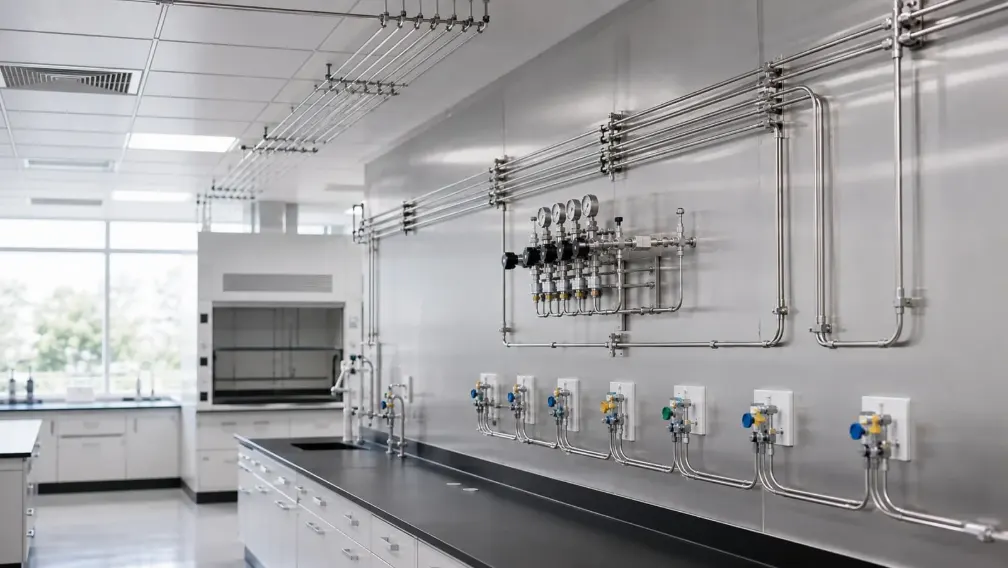
Stainless-Steel Tubing
1/4-inch Tubing
1/2-inch Tubing
Compression Fittings
Tube Fittings
Gas Manifolds
Pressure Regulators
Isolation Valves
Gas Outlets
Point-of-Use Assemblies
Flexible Connections
Cylinder Connections
Headers
Branch Lines
If a Leak Is Found
What Happens If We Find a Leak?
Identify→Secure→Depressurize→Repair→Retest→Document
If leakage is identified, the affected location is documented. The system is safely depressurized before repair. The applicable test is repeated after corrective action.
No fitting, valve or connection should be opened, adjusted or repaired while the system is pressurized.
Documentation
Laboratory Gas Leak Test Documentation
Depending on the agreed scope, documentation may include the following.
Client/project information • Gas service • Test area • Test boundary • Tubing size
Test method • Test medium • Test pressure • Operating pressure • Test date/time
Gauge identification • Calibration information • Leak locations • Corrective action • Retest results • Final acceptance
MUSK does not promise a specific client form unless it is actually part of the agreed contract.
Why MUSK
Why Choose MUSK for Laboratory Gas Systems?

01
Laboratory Engineering Expertise
Technical understanding of laboratory gas requirements, not just general plumbing.
02
Gas Distribution Systems
Experience with manifolds, regulators, tubing, valves and outlets as a complete system.
03
Professional Tubing Installation
Attention to routing, materials and connection quality throughout installation.
04
Leak Testing & Commissioning
Structured inspection, testing and documentation aligned with the agreed project scope.
05
Laboratory Infrastructure Integration
Gas systems considered alongside furniture, equipment and overall laboratory layout.
06
Turnkey Laboratory Support
Coordinated support from planning through installation, testing and commissioning.
Related MUSK Services
Explore Related Laboratory Solutions
Laboratory Gas Distribution Systems
Manifolds, regulators, tubing and complete gas distribution design and installation.
View Laboratory Gas Distribution →Laboratory Furniture
Fume hoods, benches, storage and complete laboratory furniture solutions.
View Laboratory Furniture →Laboratory Equipment
Instruments and equipment supplied and supported across Saudi Arabia.
View Laboratory Equipment →FAQ
Frequently Asked Questions — Laboratory Gas Tubing Leak Testing
Technical questions clients ask most often about laboratory gas tubing inspection, leak testing, pressure terminology and governing standards.
What is laboratory gas tubing leak testing?+
Laboratory gas tubing leak testing is the process of checking gas tubing and accessible connections for unintended leakage using an appropriate inspection or leak-detection method. Depending on the system, the inspection may include visual examination, bubble testing and suitable gas detection.
Why is laboratory gas tubing leak testing important?+
Leak testing helps identify unintended leakage at tubing connections, fittings, valves, regulators, manifolds, outlets and other accessible points. It can form part of commissioning, maintenance, modification or troubleshooting activities and helps verify the condition of the gas distribution system.
What components are checked during laboratory gas leak testing?+
Depending on the agreed test boundary, MUSK may inspect tubing, compression fittings, valves, regulators, manifolds, gas outlets, adaptors, flexible connections and accessible equipment inlet connections.
Can MUSK test existing laboratory gas tubing?+
Yes. MUSK can inspect accessible existing laboratory gas tubing and related connections. For existing systems, the inspection may use visual inspection, bubble testing and suitable gas detection depending on the gas, system condition and applicable requirements.
Can gas tubing be tested while laboratory equipment is connected?+
Where appropriate, MUSK can inspect accessible existing piping while equipment remains connected. However, a formal pressure test must not be applied through connected equipment unless its allowable pressure has been verified and the approved test procedure permits it.
Who is responsible for disconnecting laboratory equipment?+
Where laboratory equipment must be isolated or disconnected, the client or equipment owner is responsible for coordinating with the equipment manufacturer or authorized supplier. MUSK does not assume responsibility for disconnecting or modifying laboratory instruments unless that activity is specifically included in the agreed scope and authorized by the equipment owner or manufacturer.
Can MUSK disconnect laboratory equipment?+
Only where equipment disconnection is specifically included in the agreed scope and properly authorized. Where manufacturer involvement is required, the client should coordinate with the equipment manufacturer or authorized supplier.
What happens if laboratory equipment cannot be disconnected?+
MUSK can inspect accessible existing gas piping and connections using appropriate methods such as visual inspection, bubble testing and suitable gas detection. A formal high-pressure test should only be performed after confirming the pressure rating of all components within the test boundary.
What is visual inspection of laboratory gas tubing?+
Visual inspection is the first stage of gas tubing examination. It checks accessible tubing, fittings, valves, regulators, manifolds, supports and connections for visible damage, incorrect installation, corrosion where applicable or other physical conditions that may require attention. Visual inspection alone does not prove gas-tightness.
What is a bubble leak test?+
A bubble leak test applies a suitable bubble-forming leak-detection solution to an accessible pressurized connection. Continuous bubble formation indicates leakage from the inspected area. The method must be suitable for the gas, pressure, material and test conditions.
What does continuous bubble formation indicate?+
Continuous bubble growth at an inspected connection indicates that gas is escaping from that location and should be investigated. The system should be safely depressurized before corrective work is performed.
What is gas detector testing?+
Gas detector testing uses a suitable electronic detector to identify the presence of a specific gas around accessible connections. The detector must be appropriate for the gas being tested and operated according to the manufacturer’s instructions.
Can one gas detector detect every laboratory gas?+
No. Gas detectors are designed for particular gases or detection technologies. The instrument must be suitable for the specific gas and application. MUSK selects or uses detection equipment according to the gas service and project requirements.
Can MUSK test Helium gas tubing?+
Yes. Helium gas tubing can be inspected using appropriate leak-detection methods. Where enhanced sensitivity is required, suitable helium leak-detection equipment may be considered according to the project requirements.
Can MUSK test Nitrogen gas tubing?+
Yes. Nitrogen gas distribution systems can be inspected and leak tested according to the system design, operating conditions and applicable project requirements.
Can MUSK test Oxygen gas tubing?+
Yes, subject to the applicable oxygen-service requirements. Oxygen systems require appropriate attention to cleanliness, compatible materials and components, safe handling and the approved testing procedure.
What is ASME B31.3?+
ASME B31.3 is the Process Piping Code. It provides applicable requirements covering piping materials and components, design, fabrication, assembly, examination, inspection and testing. Where B31.3 governs a project, its requirements form part of the technical basis for applicable piping testing.
What is the technical basis of ASME B31.3 for pneumatic testing?+
For an applicable pneumatic test, ASME B31.3 generally establishes a minimum test-pressure basis of 1.1 times design pressure, subject to applicable code limitations and component ratings. The actual test procedure must also address controlled pressurization, examination and pneumatic stored-energy hazards.
What is Saudi Aramco SAES-A-004?+
SAES-A-004 is a Saudi Aramco engineering standard governing pressure-testing requirements. It addresses test preparation, test boundaries, test medium, pressure, pneumatic testing, preliminary leak testing, controlled pressurization, pressure relief, safety, inspection, documentation and applicable pre-start-up/service testing.
What is Saudi Aramco SAES-L-150?+
SAES-L-150 is a Saudi Aramco engineering standard covering pressure testing of applicable plant piping and pipelines. It also contains specific requirements for certain instrument impulse-line applications, including pneumatic testing and protection or disconnection of damage-sensitive instrumentation.
What is ASME Section V, Article 10?+
ASME Section V, Article 10 provides applicable leak-testing examination methods. For the bubble method, an appropriate bubble-forming solution is applied to an accessible pressurized area and continuous bubble formation indicates leakage.
What is ASME PCC-2?+
ASME PCC-2 provides requirements and guidance for repair of pressure equipment and piping and related in-service activities. Its relevance may include repair activities, testing after repair and practical safety considerations for pressure-related work.
What is design pressure?+
Design pressure is the pressure used by the engineering design to establish the required pressure rating of the piping system under specified design conditions. It is not necessarily the same as the normal operating pressure.
What is operating pressure?+
Operating pressure is the pressure at which the gas system normally operates during service. It may be lower than the system’s design pressure.
What is test pressure?+
Test pressure is the pressure selected for a particular pressure or leak test according to the applicable code, project specification, design conditions, test boundary and component ratings. There is no single universal test pressure for every laboratory gas system.
What does 1.1 × design pressure mean?+
It means 110% of the design pressure. For example, if the design pressure is 300 psi, 1.1 × design pressure equals 330 psi. For an applicable ASME B31.3 pneumatic test, this represents the general minimum test-pressure basis, subject to the code’s limitations and component ratings.
What does 1.5 × design pressure mean?+
It means 150% of the design pressure. For example, if the design pressure is 300 psi, 1.5 × design pressure equals 450 psi. However, 1.5 × design pressure must not automatically be presented as the pneumatic test pressure for laboratory gas tubing.
Is 1.5 × design pressure the pneumatic test pressure?+
Not automatically. Pneumatic testing under ASME B31.3 has a different pressure basis and additional stored-energy safety considerations. The applicable test pressure must be established from the governing code, project specification, approved test procedure, design pressure and component ratings.
What is the 25 psi preliminary leak test?+
Under the applicable Saudi Aramco SAES-A-004 pneumatic pressure-testing procedure, a preliminary leak test is performed at 25 psi before pneumatic pressure testing. The preliminary examination uses the applicable leak-detection method. This 25 psi value is a preliminary leak-check pressure and is not automatically the final service or strength-test pressure.
Is 25 psi the final laboratory gas test pressure?+
No. 25 psi is a preliminary pneumatic leak-check pressure in the applicable Saudi Aramco pressure-testing procedure. The final test pressure depends on the type of test, system design, operating pressure, component ratings, project requirements and approved test procedure.
What pressure will MUSK use to test laboratory gas tubing?+
There is no single universal pressure. The applicable pressure is determined from the test type, design pressure, normal operating pressure, connected component ratings, test boundary, project specification and governing standards. MUSK will establish the applicable pressure before testing rather than applying an arbitrary value.
Why can’t one pressure be used for every laboratory gas system?+
Laboratory gas systems differ in gas service, design pressure, operating pressure, tubing material, equipment ratings, regulators and system configuration. Therefore, the test pressure must be established for the specific system and test boundary.
What happens if connected equipment has a lower pressure rating?+
If connected equipment has a lower allowable pressure than the proposed piping test pressure, the equipment should be isolated or disconnected according to the approved procedure. The client or equipment owner is responsible for coordinating manufacturer involvement when required.
What is the difference between pressure testing and leak testing?+
Pressure testing evaluates system integrity under a specified pressure condition, while leak testing focuses on identifying unintended leakage. They may form part of the same overall testing program but are not automatically the same activity.
What is the difference between a strength test and a service leak test?+
A strength test evaluates piping integrity at an approved test pressure, while a service leak test verifies tightness under the applicable operating or service condition. The pressure, duration, test boundary and acceptance criteria depend on the governing requirements.
How long is a laboratory gas tubing test?+
The duration depends on the test type and governing requirements. For example, applicable ASME B31.3 pneumatic leak testing has a minimum examination hold requirement, while Saudi Aramco requirements may specify different durations for particular test categories. The approved project test procedure determines the final duration.
What happens if a leak is found?+
The leakage location is identified and documented. The system is safely depressurized before corrective work. The affected connection or component is repaired or replaced according to the approved scope, and the applicable test is repeated.
Can a gas fitting be tightened while pressurized?+
No. A fitting, valve or connection should not be opened, adjusted or repaired while the system is pressurized. The system must be safely depressurized before corrective work.
What is pre-start-up leak testing?+
Pre-start-up leak testing is a test performed before putting an applicable new or modified system into service to verify that the system is sufficiently tight for commissioning. The applicable pressure, medium and procedure are established by the governing requirements and approved test package.
What is service testing?+
Service testing is performed under the applicable normal operating or service condition to verify the system after installation or pre-start-up testing. The exact pressure and procedure depend on the gas system and project requirements.
Can MUSK inspect gas manifolds?+
Yes. Gas manifolds can be included in the inspection or test boundary where they are part of the agreed laboratory gas system scope and accessible for examination.
Can MUSK test laboratory gas outlets?+
Yes. Accessible laboratory gas outlets and point-of-use connections can be included in the inspection or test boundary where they form part of the agreed scope.
Can MUSK test stainless-steel gas tubing?+
Yes. Stainless-steel laboratory gas tubing can be inspected and tested using appropriate methods according to the tubing system, gas service, pressure, fittings and applicable project requirements.
Can MUSK test 1/4-inch laboratory gas tubing?+
Yes. 1/4-inch laboratory gas tubing can be included in inspection and testing subject to the system design, tubing specification, fittings, operating conditions and applicable testing requirements.
Can MUSK test 1/2-inch laboratory gas tubing?+
Yes. 1/2-inch laboratory gas tubing can be included in inspection and testing subject to the system design, tubing specification, fittings, operating conditions and applicable testing requirements.
Does MUSK provide laboratory gas tubing installation?+
MUSK provides laboratory gas tubing installation and related gas distribution support as part of applicable laboratory projects and agreed project scopes.
Does MUSK provide laboratory gas distribution systems?+
MUSK can support laboratory gas distribution projects including gas tubing, manifolds, regulators, valves, outlets and related installation, testing and commissioning activities, subject to the agreed project scope.
Does MUSK provide laboratory gas commissioning?+
MUSK can support laboratory gas system inspection, leak testing and commissioning activities as part of the agreed project scope and applicable project requirements.
Does MUSK provide turnkey laboratory solutions?+
MUSK supports turnkey laboratory projects that may integrate laboratory planning, furniture, equipment, gas distribution and related technical services, subject to the agreed project scope.
Does MUSK provide laboratory gas services in Saudi Arabia?+
Yes. MUSK is based in Saudi Arabia and provides laboratory-related gas distribution, installation, inspection, testing and technical support according to project requirements and agreed scope.
Safety
Laboratory Gas Testing Safety
Pneumatic testing involves stored energy and must be planned and controlled accordingly.
Test areas must be controlled, with personnel kept away from line-of-fire areas.
Pressure must be increased gradually, in controlled steps.
Appropriate pressure relief protection must be provided where required.
Calibrated gauges and pressure-rated hoses and fittings must be used.
Repairs must only be performed after the system has been safely depressurized.
Nitrogen and Helium can displace oxygen; adequate ventilation is required.
Gas-specific safety requirements must always be followed.
Need Your Laboratory Gas System Tested?
Whether you are commissioning a new laboratory, modifying an existing gas distribution system or investigating suspected leakage, MUSK can support the inspection and testing of accessible laboratory gas tubing and related components according to the agreed project scope and applicable requirements.
This page provides general technical information about laboratory gas tubing leak testing for planning purposes. It does not constitute an approved project test procedure, and it does not represent certification, accreditation or approval by any code body, Saudi Aramco or other authority. Project-specific test methods, pressures, durations, boundaries and acceptance criteria must be confirmed against the governing project specification and applicable standards before any testing is performed.